
Child Custody & Support—clear plans that put kids first and reduce conflict
Whether you are filing for the first time or updating an existing order, you need a plan that works in real life. We help parents understand legal vs. physical custody, build parenting-time schedules that fit school and work, and align child support with guideline factors—without unnecessary drama or delay.
- Legal and physical custody explained in plain language with practical pros and cons.
- Parenting-time frameworks (week-on/week-off, 2-2-3, 5-2, extended summers, holidays, travel) tailored to your family.
- Child support calculations that reflect income, overnights, health insurance, and childcare add‑ons.
- Tools for communication and exchanges that lower conflict and support your child’s routine.
- Modification and enforcement guidance when circumstances change or orders aren’t followed.

Our approach: stable schedules and child‑first decisions
We focus on developmentally appropriate plans, clarity around exchanges, and support orders that reflect real budgets. When parents understand options, they make better decisions—often without courtroom escalation.
Stability over chaos
We build routines around school start/stop times, daycare, and activities—reducing last‑minute changes and stress.
Communication that works
Clear channels (e.g., co‑parenting apps) and decision protocols reduce conflict and create a record when needed.
Child‑support clarity
We model guideline scenarios based on income, overnights, health insurance, and childcare to arrive at realistic numbers.
Flexibility for change
Jobs, schools, and children’s needs evolve. We draft modification‑ready terms to handle foreseeable changes.
Safety and boundaries
When safety concerns exist, we incorporate appropriate safeguards, supervised time, or step‑up plans as warranted.
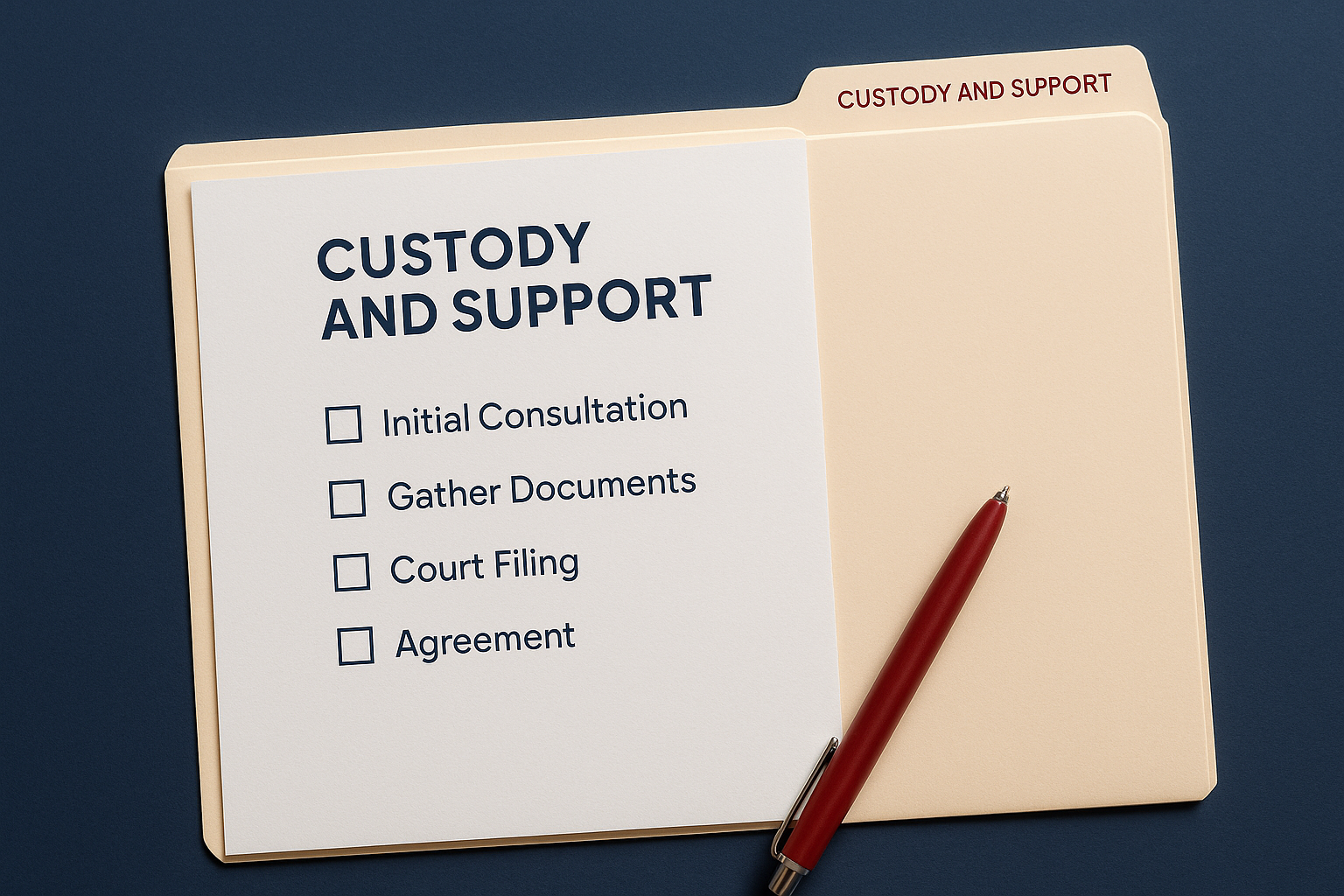
Your path from today to a workable order
- Intake and triage: We review immediate concerns, school/work schedules, and any safety issues; set communication rules early.
- Temporary orders: If needed, we seek short‑term custody, parenting time, and support to stabilize routines while the case proceeds.
- Information and evaluations: Exchange financials, school/health info, and—when appropriate—use neutral evaluations or parenting coordinators.
- Negotiation and mediation: We prepare realistic proposals and pursue settlement paths that save time and stress.
- Final orders: Draft clear, enforceable language on decision‑making, time, exchanges, travel, holidays, and expense sharing.
- Implementation and follow‑up: We track first weeks of the schedule and discuss future modification triggers and processes.
Many matters resolve through negotiation or mediation. If litigation is necessary, we are prepared and focused on the facts that serve your child’s best interests. For a broader overview of how cases flow at our firm, see Our Process .
Want a neutral primer on core terms? See the Legal Information Institute’s overview of custody concepts at law.cornell.edu .
Child Custody & Support FAQs
Practical answers to help you plan next steps with confidence.
Ready to build a parenting plan that works day to day?
Tell us what’s happening now. We’ll review conflicts, outline options, and give you a realistic timeline for temporary and final orders—often with same‑day response.
Page last updated: September 12, 2025